Glucosamine, One of the Most Popular Joint Supplements, May Be Linked to Increased Risk of Alzheimer’s Disease and Death
Millions of people take glucosamine every year to support joint health and help manage osteoarthritis. However, emerging research suggests there may be reasons for caution.
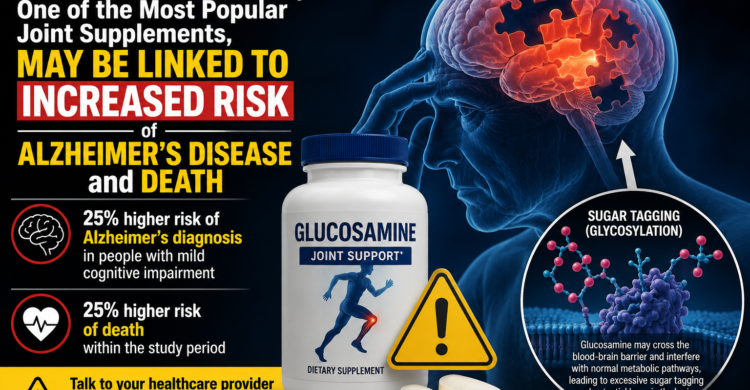
A study conducted by researchers at the University of Florida found that glucosamine use was associated with a 25% higher risk of receiving an Alzheimer’s disease diagnosis among individuals with mild cognitive impairment. The study also reported a 25% higher risk of death within the study period among glucosamine users.
Researchers suggested that glucosamine may contribute to metabolic processes that could be harmful in individuals already at risk for Alzheimer’s disease.
One possible explanation involves a process known as “sugar tagging” (glycosylation), where sugar molecules attach to proteins or fats inside cells. This process is essential for normal cellular function. However, because glucosamine is a sugar-like molecule, researchers believe it may cross the blood-brain barrier and potentially interfere with normal metabolic pathways, leading to excessive sugar tagging and unwanted effects in the brain.
While glucosamine continues to be widely used and may benefit some individuals, these findings highlight the importance of discussing all supplements with your healthcare provider, especially if you have concerns about cognitive health or a family history of Alzheimer’s disease.
As always, more research is needed to fully understand the long-term effects of glucosamine supplementation.



Better than McGill University!
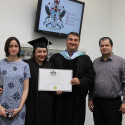 I sincerely appreciate all your advice and your work to give us the best means to improve our odds to succeed in this new path. Your speech at graduation ceremony was very inspiring. As you said, you will always be part of the change in our lives, an important part, let me complete, and I will always be grateful to you for all the knowledge that you have transferred to us but most of all, for your devotion as a teacher and your engagement to your students to make successful people of us. Words are not enough. Thank you. .
Irmina Toledo Gehrmann, DO (Spain)
Hi Dr Pourgol, Just wanted to let you know I am enjoying your online classes, I like the fact that you use the skeleton and then the actual human patient, it really drives the point home, I especially like the Ethics and Clinical Management lectures, I thought they would be boring, but your personal experiences make it very inspiring. Thanks.
Dr Randy Nagir, ND (San Fernando, Trinidad & Tobago), 3rd semester National University of Medical Sciences (Spain) student – Doctor of Osteopathy program
Dr Randy Nagir, ND